Total Pageviews

Thursday, July 9, 2026

GOLD, THE DOLLAR, STABLE COIN and QUANTUM COMPUTING


There is a debate in progress between those who are convinced that China is leading a dedollarization campaign that is bound to succeed, and those that believe that stable coins are going to make the dedollarization process impossible, or at least very difficult.

It should be noted that proponents of both theories think the primary winner of either scenario will be gold.  

Alaisdair McCLeod makes a convincing case that China has the ability and a coalition to bring about a gold linked (though not, at first, directly convertible) settlement currency that will make the dollar far less attractive in the the global commodity trade.  He thinks that this will bring about a great drop in the value of the dollar and a commenserate rise in the value of gold.

Brent Johnson of the dollar milkshake theory thinks that though there is a global desire to dedollarize, it will be nearly impossible to do so because the proliferation of dollar denominated stable coins will sweep the world and make the value of the dollar rise.  Ironically he feels that this rise in dollar value will cause a credit crisis that will make the value of gold soar.

Though both theories favor gold, the time frame suggested by both theories for the rise in the value of gold are very different.

I would say that those who are pounding the table for stable coin are missing two extremely important problems.

First, as delineated compellingly by Jim Rickards, the fact that there is no oversight for stable coin will necessarily lead to abuse.  And it only takes one bad actor to destroy the faith in the entire system.  Each stable coin is theoretically backed by a dollar of treasuries.  But without enforcement, oversight, or even transparant  accounting, anyone can cheat, and nobody would know until a problem arose in redemption.  At that point, a problem could lead to mass redemptions and a collapse of the entire system.

Second, the block chain technology upon which all crypto is dependent will be hackable by Quantum computing by as early as 2029.  It is already hackable right now, but there is not yet a computer with sufficient power to generate the hack.  That, right now, is three years away.  But it could come sooner.

That it will come is not in question.  Why this doesn't make the crypto community more nervous is a complete mystery.  Maybe they think if they ignore this problem it will just evaporate. But when it happens it will make gold, the barberous relic, all the more attractive. 

And a gold linked Chinese currency will then also be all the more attractive.


Wednesday, July 1, 2026

Modern collector gold: A new market.


New markets are difficult to gauge because they have no real track record.  But one interesting market that is obviously tied to the gold bullion price is the low mintage collector gold market.  I'm talking about the global central mints -  I'd stay away from anything that is private mint - prinicipally because there's no guarantee that private mint gold is actually gold, or that mintages are accurate.

But the British Royal mint (and its client mints in the British dependencies), the Royal Dutch mint, the French Monnai de Paris especially are all issuing gold coins with mintages as low as 20 or 30 pieces up to several hundred pieces.  Because all these mints are producing a myriad of issues every year, the premiums for these coins can often  be very low over bullion when bought at auction at Heritage and Stacks.  And because the US private investor is largely out of the market, and the Asian investors largely buy Chinese Mint issues, and British and European investors are largely strapped for cash right now, this market is undersubscribed vis a vis the bullion market where most high value institutional and ultra rich investors buy in quantity.

The neglect of a market makes it immediately interesting.  And most interesting is that over the last 30 years of these issues, I've seen several issues attract a significant collector bid.  Take the French mint Sower five franc gold issues from the mid 1970's issued in quantities from 35 to 120 pieces (pitured above).  These low mintage coins could have been bought for bullion even fifteen years ago. Now they trade at 3-4 times bullion.  That is a significant premium.  The same can be said for some of the popular British mint coins based on reproduced masterpieces from earlier centuries: the three graces, the victoria gothic portrait, the pistrucci waterloo victory, all are relatively recent and already trade to 2-3 times bullion.  

Now, will this continue into the future?  When bullion is $10,000 dollars an ounce will these coins trade for 20-30,000 dollars?

That's very hard to say.  Probably the premiums will tighten.  By that logic bullion is a better bet than those issues that have already taken off.

But for those issues that still trade very close to bullion, the downside is very hard to see.  When only 100 coins have been minted, in a global market with billions of potential buyers, some of these issues will become valuable.

Right now, the entire gold bull has been driven by central bank buying and the buying of the ultra rich.  Obviously they do not care much about collector coins.  It's too time intensive for those figuring how to invest billions and hundreds of billions.  But enventually, as the cost of living continues to soar, and other more traditional investments cease to provide returns, it is natural that at some point you'll get a avid retail demand for gold.  Then those coins whose designs are paticularly impressive in very low mintages could turn out to be highly sought after.

Saturday, June 27, 2026

THE GOLD DIVE: WHEN WILL IT END?


There are two aspects to the move in any market.  There is math.  And there is narrative.

I love the gold market because it runs largely on math.  In the short run (over a period of months - sometimes at the extreme a year or two) the narrative can take over and knock the primary trend for a loop.  But over the long run which usually reasserts itself over a relatively short period of time, the math of the gold market is ineluctable.  And that math says that gold moves up in value as the value of the paper currencies in which it is denominated are inflated away.

That is math.

The current narrative is that the Fed is tightening.  How can they tighten when the debt is spiraling out of control?  They can't.  In fact the Fed and the treasury are currently printing trillions to support US debt auctions which are grossly undersubscribed and US Stock market, which must stay afloat for the US economy to stay afloat.  The tightening is all narrative.  The easing is all math.

In the stock market for example, narrative can prevail over math for years and years on end.  That is how Spacex can be valued at 100 times sales because its P/E if infinity.  It has no earnings.  It lost 40 billion dollars.  But Elon Musk is now a trillionaire because he is able to sell the narrative that one day there will be data centers on Mars.

Maybe there will be data centers on Mars.  And maybe I'll replace Jalen Brunson next year as the point guard for the Knicks.  It's possible.  Though I have two plastic hips, and even 40 years ago my jump shot was pretty inconsistent.  But it's possible.  If only I could sell that narrative I could be a trillionaire too.

But I can't.  So the best I can do is stick with the math.  And the math of the gold market tells me that some time quite soon gold will be trading much higher as the value of the dollar is inflated away.  Just as the math of the stock market says that valuations will eventually revert to a mean.

But the math of gold tends to dominate the gold market.

So when will the math reassert itself over the "tightening" narrative?

When A) the fact that consumer spending is dependent on wages which are stagnant while prices continue to climb mercilessly reasserts itslef.  How does the consumer keep spending?  By going deeper and deeper into debt to consume needs like housing, food, energy, insurance, education and health care (much of which is excluded from CPI data).  Consumer debt is at record levels and climbing. About 90 percent of the US populace is functionlly insolvent.  Eventually that huge segment will become dangerously unhappy and need to be placated with even more printed money.  B) the fact that Federal Debt auctions are dangerously undersubscribed and the Federal Government has resorted to funding itself almost exclusively at the very short end (which is a form of QE) finally creates a debt crisis that has to be bailed out with another several trillion dollars. of printed money C)  The perpetual war machine that is now demanding another half trillion of printed money and has already spent a half trillion of printed off budget money this year adds a dangerous level of printed  money to the perpetual dilution of the dollar.  D) The no hire no fire economy creates a jobless future for an entire generation of college grads entering or not entering the workforce with hundreds of thousands of dollars of college debt.  Eventually they too will need to be placated with more printed money.

The whole future of a viable America depends on printing ever greater amounts of money to be distributed at the whim of a highly centralized government, added to a hundred trillion dollars of already incurred unfunded liabilities.  

This is why the math of the gold market is stronger than temporary spun narratives.


Saturday, June 13, 2026

Techtonic Shift and Gold


Two extraordinary flow of funds shifts are now beginning to hit the US financial markets.

1) Japanese Central Bank is comitted to raising rates.  This means that two trillion dollars of Japanese yen carry trade invested in US financial markets will be unwound as that money heads back into Japan.  That is a significant outflow especially form our debt markets.

2) The Chinese Government and Populace combined have another trillion dollars invested in the US financial markets.  China has just announced that going forwards investment in any US financial markets will be illegal.  And China has two years to unwind and repatriate all investment.  Anything remaining after that time will be coniscated.

This alone will put tremendous pressure on the US ability to fund it massive and rapidly growing debt (nearly 40 trillion dollars plus another 100 trillion of unfunded liabilities).  The debt is now growing at a rate of a trillion dollars every hundred days.  And that doesn't include funding for the forever wars we are now engaged in that by conservative estimates will add another trillion dollars per year to our deficits.  Don't even count the vanity building/celebration projects that are set to add a few hundred billlion.  That's just a rounding error at this point.

But add to this pressure the fact that tarrifs by design are meant to decrease our financial acount surplus.  Every dollar for which this policy succeeds is a dollar not available to be invested in US debt.  To call this the most baffling policy goal in the history of finance would be an understatement.

The pressure on our debt markets is so extreme we now have everyone from Stanley Druckenmiller to Ray Dalio to Jamie Diamond to  Hank Paulsen to David Stockman to James Grant to Jim Rickards and a host of billion dollar fund managers are warning that a Debt crisis is imminent.

Question: How can the fed do anyting but ease and then print in the face of an imminent debt crisis? (I know the market is placing a 68 percent chance of a rate raise.  That's a strange joke.)  And this in the face of o 4.5 percent CPI and 6.8 percent PPI.  And that's just official inflation.

So GOLD?  Draw you own conclusion.  But consider this: when the credit market falters, the Fed will have the choice of saving the credit market or saving the currency.  Which will they choose?  If they choose the credit market (correct answer!) the currency will crash and gold will skyrocket.

Wednesday, June 3, 2026

COLLECTOR GOLD VS BULLION


Anyone who's been in the precious metals market for a significant period of time will have some level of interest in the collector market.  

For most Americans that means short print modern bullion issues - proofs, enhanced finished coins, specially produced limited issue images.  These often sell at large premiums to bullion.  There's no real track record as these issues are at most a few decades old, so no real analysis is possible.  I think if you can get them relatively close to bullion there's little harm in them and some possible upside.  For this you have to get them directly from the national mints or in bullion auctions at Heritage or Stacks where you can bid a bit over melt.

But those with a relatively thorough education may be tempted by the historical coin market.  British, French, Spanish, Italian, Dutch Latin American, Medieval, Byzantine, Roman and Greek coins.

All of these markets are booming and have been booming for over two decades.  And they've recently moved up noticeably slong with the rest of the hard asset market.

The one thing you really need to succeed in these markets is a strong knowledge of the History of the period and region that inerests you. You can always momentum trade.  But if you buy a coin that has particular Historical importance and it is in attractive condition, over time you'll do well.  And many who play in these markets don't have a sound historical background, so that will give you an edge.

The second thing is condition.  A coin must be atrractive and it must be unaletered.  If it is certified unalatered (it has a numerical grade from NGC or PCGS) it is as good as unaltered.  As far as atractive is concerned, there again, you need to trust your own eye.  If a coin has been awarded a Star or perhaps a fine style designation, that will give it some bump in price, but even with thses designations, if the coin is unattractive, over time, it won't go up all that much in price.  Because, most oftern, those buyers at the top of the historical markets do have some aesthtetic training (and coin graders do not.).

The third thing is the market itself.  There is a tremendous amount of momentum trading and a lot of that comes from particukar groups chasing particular coins.  For example the Japanese love the German Salvator Mundi medallions in gold.  But if there is a credit crisis in Japan, the value of those medallions will plumet because all the buying is there.  Similarly the Japanese love Queen Victoria.  But so do the British, and so do many Americans, so if there is a credit crisis in Japan, the value of Victoria coins should be stable.

The only way to understand these aspects of the market is to be in the market full time for years.  Otherwise it is smart not to momentum trade, but rather buy areas you truly relate to historically and aesthetically,

Finally a word about Ancients.  These are becoming inceasingly popular.  I love the area personally,  But to do well here financially it is best to have a very sound historical background.  There are a lot of rare coins compared to other eras.  But many of them will never appeal to those other than numismatic specialists,  Those that appeal for broad historical reasons are safest.  And here, again, your own eye is paramount.  You have to know the diffence between a coin engraved by a master and a coin engraved by some schmuck who got a job at the mint.  Do not rely on the holders for this.  They're good for the preservation grades but aesthetially they mean little to those with real money in this numismatic area.

And finally it is best to specialize.  Don't diversify until you master an area.  Beause all the edge goes to the specialist.

Tuesday, June 2, 2026

GOLD AND THE ECONOMY


When assessing a portfolio's overall need for gold you obviously have to compare that need to the overall performance of the economy.

Easier said than done.

There are many economies.  There's the financial economy that serves those with financial assets.  That is explicity the top 10 percent, although the lion's share of these assets and associated gains go to the top tenth of the top 1 percent.

By every account that part of the economy is doing well, depending high how up you are in the top 10 percent.

Then there is the real economy that produces goods and services that can be split into things that those with assets like to buy for themselves and things that are non discressionary like food, insurance, education, shelter, health care etc., that even those with no assets must purchase.

This part of the economy is doing real well for those with assets.  And even for those without assets it's doing okay right now because these are things  that must be purchassed.  However the 90 percent is currently going deep into debt to be able to purchase these things.  Even some areas of discessionary purchase for those below the billionaire class are beginning to feel a pinch.

Finally there is the the monetary economy.  This measures the monetary health of the economy.  How much debt does it take to keep the economoy operating?  How much return does the economy provide for a dollar of debt?  And how much money is being created when we produce this debt?  ANd most important, what does the debt/money inflow do to prices over time?

This part of our economy is deeply deeply ill.  Perhaps terminally ill.  According to the Congressional Budget office, sovereign debt is growing at 8 percent per year.  Debt service is over a trillion per year.  And with long rates backing up to 4.5 percent that number is growing.

And it is this Deeply Ill Monetary Economy that necessitates the purchase of gold.  Gold is you only hedge for wealth preservation for the necessary monetry debasement that is happening right now.

At some point this monetary debasement will morph into a debt crisis that will produce something akin to hyperinflation - or deep dark stagflation.

A lot of people think we are just about there.  Ray Dalio.  Stan Druckenmiller.  Jamie Diamond.  Hank Paulsen.  Luke Gromen.  Ed Howe.  Rick Rule.  Peter Grandich.  Frank Giustra.  These are not weird alt bloggeres.  They're high net worth money managers. They all think you need gold for the inevitable credit crisis.  Maybe they're right.


Wednesday, May 20, 2026

War and Gold II


Despite the fact that kinteic war in the gulf  no longer serves US interests (if it ever did), there is no way of disengaging without ceding the Straight of Hormuz to Iran/China.

As long as ships are paralyzed the pressure on oil remains high and therefor so does the pressure on gold.

THis is very Deflationary.  It will lead to a   global economic slowdown, shortages of food and energy that will metastasize into famines and recessions, and possibly derpressions.

On the other side of this elquation is the fact that war itself is extraordinarily inflationary.  It is tremendously expensive for all participants.  This means a ratcheting up of debt levels everywhere.  And in the US it means ramping up the printing presses to levels never before seen in history - considering the current debt load and the unprecedented levels current of spending.

The US is already demanding an extra trillion for the war machine.  And once the war machine revs up it is insatiable.

Why?

Because in a debt soaked economy the only way to keep the risk markets from crashing is to keep the deficit spending levels soaring.  And the trillions for the war machine ends up in the risk markets.

This (money printing) is paid for as a regressive tax on working Americans.  And it benefits the billionaire class that controls the Military Industrial complex.

So, on balance, the initial thurst for Gold is down with the initial deflationary pressures but ultimately way up as the inflationary pressure of the war machine kicks in.

So, the trick is look through the initial Gold reaction to the ultimate Gold result.

Sunday, May 10, 2026

WAR OIL AND GOLD


The Iran war is effectively over.  

The US can't escalate without sending oil to $200 over night, and Iran has demonstrated they are willing endure months of privation as long as they can make the global economy suffer witht them.  

The US can't tolerate any more suffering than necessary with food and energy costs spiraling out of control (along with everything else.)

So the war is over.  

That means the Straight of Hormuz is now under control of Iran/China/Russia.  It is to their benefit to allow oil to pass through the straight but it will be on their terms.  

This means A) oil is likely to remain closer to $100 dollars than the $50 dollars level before the war.  In fact, many analysts have it climbing steadily towards $150 as so much middle east oil has been taken off line and it will take many months just to get back on line.  This is excellent for GOLD because it means inflation will keep spiraling out of control.

B) The Middle Eastern countries will be able to begin selling oil again, so they can stop selling gold, and they will undoubtedly use the oil proceeds to buy back the gold they had to sell when the oil sales stopped flowing.  Again, excellent for gold.

C) the massive cost of the US war machine will add an extra TRILLION to the budget.  That is money that has to be printed out of thin air.  This is the best news for gold of all, especially gold priced in dollars - since it destroys the value of the dollar.

So, in all excellent for gold.  In fact, the perfect strorm.

Add to that, the certainty that a Fed dominated by the current adminsitration is sure to cut rates into this inflationary storm.  

That will add jet fuel to the gold bull.

Friday, April 24, 2026

The coming Gold Pivot: Inflation is the point


When will gold finally take off again?

The moment the new Warsh Fed begins cutting.

And he will cut all the way down to 2 percent.  And then lower.

There's a lot being made of Warsh being a data dependent and administration independent Fed Head.  That's a joke.  He's been put in to cut rates.  Everybody knows it.  Few can say it. Because that would make it seem like nobody cares about inflation.

Of course the administration does care about inflation.  They need it very badly.  It's the only way to deal with a trillion dollar burn rate every hundred days.  If they don't get the requesite inflation they get a debt depression and nobody wants that.

But nobody can acknowledge the need for inflation because that would spook a shaky consumer who would then desperately binge buy to front run the coming inflation which would provoke a hyper inflation.  And nobody wants that.  That's what's meant by managing inflation expectation.

A nice managed stagflation with aburdly understated government stats is the best we can hope for.  All the while convincing the consumer that the inflationary yoke is transient and will surely dissipate as soon as A) oil prices subside, B) the AI boom boosts productivity, C) the national reshoring of industry kicks in, D) The tooth fairy puts big fat refund checks under everyone's pillow.

But really, gold will skyrocket the moment Warsh starts cutting even while 90 percent of the hard working consumer base is barely hanging on pay check to pay check, while everything from housing to energy to insurance to health care to education to food costs keeps spiraling out of control.

So hang in there with your gold positions because Warsh will not disappoint.

Wednesday, April 22, 2026

China and Gold


It's no secret that China is driving the global gold price right now.  The central bank and sovereign wealth fund buying is global but China is the driver.  They have set up gold exchanges and warehouses strategically throughout the world; they have been selling US treasuries to buy gold and they have started to accept gold in payment rather than US dollars for certain strategic commodities.

In fact, the narrowing of the US trade deficit over the last 5 months is entirely due to the US exporting gold to China.

So what happens if to the gold price if China collapses, as many in the US are predicting?

It's a fair question, even though many of the US analysts who are predicting the collapse of China like Ed Dowd are also some of gold's biggest proponents.

The major argument for China's collapse is based on demographics.  The argument goes that the Chinese birth rate is rapidly decreasing so that you have a diminishing worker base supporting an increasingly aging population.

What this argument misses is A) the massive population in china still produces 4 times the number of youthful workers that the US population (also decreasing) produces.  There are 80 million Chinese under the age of 5 and only 18 million Americans.

But what this argument also misses in the structure of the Chinese economy is such that the aging population doesn't nearly consume the percentage of the output that the aging US population consumes.  First, it is about 1/5 as expensive to live in China so that the savings of the aged last much longer there, without nearly the same amount of government support.  Second the Health Care is set up in such a way that the young are supported equally with the aged unlike here in the US where nearly 50 percent of the health care outlay supports procedures for the aged which respresent about 15 percent of the population.

But most important, the Chinese economy does not run on prerpetual negative real rates which is a constant transfer of wealth from young to old, from worker to asset owner as it is here in the US economy.

Also, whereas the Chinese economy socializes the profits of the wealthy which benefits the younger workers, the US economy socializes the losses of the very wealthy which penalizes youthful workers.

This makes the Chinese economy more resilient for the youthful workers than many in the US seem to realize.  

The second criticsim of China has to do with the inefficiency of the central government which resulted in an overbuilding of the housing sector to such an extent that collapse is imminent.

This argument is generally put forth by analysts who have never been to China.  Those western analysts who live in the Far East like Mark Faber and Louis Gave tend to point out that the Chinese Central Committee has shifted away from putting resources into housing (for nearly a decade now)  towards building extremely efficient hi tech industries like Electric Cars, AI, robotics and aerospace that are at least competitive with western industry and in some cases superior.

Finally the Chinese have managed to stay away from perpetual forerver wars that eat trillions of dollars of resouces in completely unproductive endeavor and they have spent money rather on buying up the commodity minings and processing sectors around the globe.  In this way that have already achieved escalation dominance for commodities like Rare Earths and Silver that are crucial to the new hi tech industries.

This isn't to say China is in any way superior to the US, but I don't think there's any good  reason to feel the Chinese collapse is imminent.

Wednesday, April 15, 2026

The GOLD PIVOT - Nobody rings a bell.


If you listen to all the popular technical analysts you hear that gold must retrace to $3500 to $3800 for a back the truck up moment when all is clear to load up on gold again.

Back the truck up moments only appear in fantasy land.  Or at the end of long crushing bear markets.  And then nobody will back the truck up.  They'll be driving off in the opposite direction and they'll laugh at you if you disagree.  That was gold back in 2002.  I remember because luminaries like Richard Russel (RIP) and James Rickards (who's currently predicting gold at $27,000) were urging clients to buy gold at $350 and few were listening.  Most were jeering.  

But in the middle of bull market corrections, back the truck up moments never occur.

And that's where we are now.

The war had been the most recent wild card affecting the gold price.  But as it grinds on in its forever fashion with brief kinetic explosions and then hastily patched truces, gold begins to assimilate and acclimatize to the short term trading effects and reverts to its long term purpose as the true and only effective Debt and Currency Debasement Hedge.

Because the only certainty about war is that it is massively inflationary.

It is very expensive to wage war.  And the supply chain disruptions - especially when involving oil - cause huge spikes in the cost of food and fuel - and most everything else.

And in the world's most indebted economy (perhaps history's most indebted economy) with 40 trillion dollars of sovereign debt and another 150 trillion in unfunded liabilities and a banking system laden with tens of trillions in mark to model debt that needs to be refinanced this year and perhaps most troubling a TWO TRILLION DOLLAR PRIVATE CREDIT HOLE that is in the process of imploding as I write - and it will all have to be bailed out by the Fed - the added burden of WAR DEBT and Disruption will only put the gold price on steroids.

When?

Now.  

I can't tell you gold skyrockets it ten minutes, but let me give you some numbers that analysts who got the gold bull right before it happened as predicitng right now: James Rickards: $27,000, Simon Hunt: $35,000, Michael Oliver $8,000, Ed Dowd $10,000, and luminaries like Stanley Druckenmiller and Ray Dalio are urging investorts to move at least 20 percent of their entire portfolio into gold to hedge the inevitable debt crisis.  Even stock jockey banks like JP Morgan, UBS, and Wells Fargo have year end gold prices above $6000.

So don't wait for a back up the truck moment.

That moment came in 2002 and it's not coming back until some sort of new currency system is ushered in by whatever governments survives the debt implosion.

Thursday, March 26, 2026

War and Gold: When will gold pivot?


To figure out when gold will exhaust this downswing you have to understand the mechanics of the war's effect on the economy.

First the war will continue because it is in the best interest of 2 of the parties to continue - Iran because the war unites a fractured country against an external enemy and Israel for the same reason.  It is in the US interest to end the war - but it can not do so without admitting defeat, or just leaving the Strait of Hormuz under Iran's control, which it will never do.

So the strait of Hormuz will remain closed and oil and inflation will soar.

Right now this is the war's main economic thrust - sending oil higher, debt higher, and thus long rates higher.  The rising oil price and the rising rates weigh on the gold price for short term trading reasons.  As rates rise, money rotates out of gold and into fixed income.  Algorithms have been written that effect this automatically.  In the short run the swiftly rising inflation concerns cause this rotation.  And gulf sovereign wealth funds must sell some gold to bridge the gap of the loss of oil revenues from the closed strait and destroyed infrastructure.

In the longer run - meaning months (not years) - the swiftly rising debt combined with the US militaristic policies that repell the rest of the world from buying our debt are stronly supportive of a higher gold price.

At some point as rates and debt rise, a debt crisis becomes ever more of a certainty.  Thirty trillion dollars of debt financed at under 2 percent are going to have to be refinanced this year - 2026 - at over 4 percent.  US Banks are carrying trillions of dollars of underwater loans in commercial real estate, in delinquent consumer debt, and in high yeild debt incurred by zombie corporations taking advantage of compressed spreads during years of ZIRP policy.

The incoming Warsh Fed has already comitted to easing.  They will receive little push back from the financial community in the face of this incipient debt crisis. Many hedge fund billionaires like Stanley Druckenmiller (who hired and trained Warsh and Treasury Secretary Bessant at his hedge fund) and Ray Dalio, are putting out videos warning that this debt crisis can not be avoided even with Fed easing.

But the Fed easing - even in the face of drastically elevated inflation - especially in the face of drastically elevated inflation - will certainly provide the fuel for the next - violent - leg up in gold.

As will the inevitable countless trillions in bailout money that the Fed will havee to provide to support the banking system.

The problem as an investor is if you wait for the easing you'll miss the move.  Because gold will undoubtedly move well in anticipation of this certain easing.


Friday, March 20, 2026

THE WAR AND GOLD


Gold has dropped precipitously since the beginning of the war.  This has confused many who assumed that gold is a hedge against war.

Gold is a hedge against monetary instability.  War produces monetary instability - over time.  So over time  gold is a hedge against the monetary instability produced by war - but it does not react to fighting itself.  The fighting in the short run seems to be causing some to sell their most profitable investment (gold) to stock up on weapons and oil.  Even with the massive sell off, gold is still the most profitable investment year to date!

But gold will react over time to the debasement of the currency that must occur to support the fighting and offset the tremendous increase in commodity prices: in this case especially, in oil, feritlizer, refining processes and food.  All essential expenditures for the average citizen.

Already, this fighting has resulted in an appropriation of 200 billion dollars for supplemental spending.  That covers the first 4 weeks of fighting. (and this is on top of the current  trillion dollars of spending every 100 days.  The most in US history.)

Already the cost of oil has gone from about $60 to aboutn $100.  Just in the first 4 weeks of fighting.

The United States has stated it has already won the war.  Therefor, we must conclude that victory in this war will do nothing to slow down the pace of war spending, since we still need the supplemnetal 200 billion dollars. 

And victory has done nothing to open the strait of Hormuz, so we must conclude that they will stay closed.  Therefor, over time, affected commodities like oil, refining capacity, and food will continue to rise in price.  Subsidies to the 80 percent that lives hand to mouth will be required, just as it was during covid.

So when will gold start to reflect the resultant degradation of the currency?  Well, most obviously when the new Fed comes in, and the new Fed chair begins to cut in support of the war effort in spite of the rise in inflation.

Surely, he won't do that?

Surely, he will.  Otherwise he would have not been selected for the job.  The odds on a Warsh rate  cutting regime according to Polymarket are 87 percent.   I would place them at 100 percent.

But it won't take that long.  Because the war will reinforce for global central banks urgent need to continue to diversify away from the currency of the country that is waging this most destabilizing war

And most obviously the global rise in long dated rates puts massive pressure on debt service which necessitates ever more printing of currency to service the growing debt..

There's no timing for this type of situation.  But gold will resume its rise sooner, rather than later.  Not because ot the death and destruction.  Because of the expense of the death and destruction in a world economy already stressed by excessive debt.


Wednesday, March 4, 2026

WAR IS EXPSENSIVE -


The old saw is that gold is a safe haven asset.

Maybe. 

But event driven investing is short term.

Long term, Gold rises as paper currencies are debased.  This is just common sense.

And nothing debases the currency like War.  

If you look at the current war, missile drones cost about $20,000 to $50,000.  Russia and China can supply Iran with unlimited  missile drones.  The cost of the defense systems agains these drones - like the Patriot missile system costs a billion dollars for a the battery and an addtional 4 million dollars per missile.  If the US wants to continue to arm its Middle East allies against the Iranian barage, the cost will be astronomical.

That doesn't take into account the cost of mainting war ships in the gulf and sending our own fighter jets across the world to drop bombs.  Then there's expanding the military and getting troops across the world.  Maintaining supply lines...

Then there's the disruption of supply chains and the increase in commodity prices, especially oil price - even though, over long periods of time, energy is abundant.  It doesn't matter, because when there are big discruptions in supply chains the transporting of energy can become prohibitively expensive.

Then there's the loss of trust between nations.  This too is inevitable, and this has an adverse effect on the cost of doing business.  Treaties get broken.  Trade alliances are ruptured.

It's all very expensive. 

And where does the money to pay for it all come from?

We print it.  Plain and simple.  We print it.

That means everyone pays for it by having our currency debased.

It also means we have to issue more and more debt.  But as our society because increasingly belicose, we find there to be decreasing interest in other countries in buying our debt to subsidize our wars.  So we have to buy all of our own debt.  This debases the currency even more.

In fact, at some point this leads to hyperinflation.  If we're very lucky perhaps we can control that for some time by opting for a torpid stagflation.  That's really best case scenario, and we're not far off from it right now.

None of this is very controversial or original, but somehow it gets lost in the race to justify all the dealth and destruction.

If you can't see how that, over time, must incresase the value of Gold, well, then maybe you're better off buying something else.

Saturday, February 21, 2026

Tarrif ruling explodes the exploded deficit: Gold and Silver explode


The most important aspect of the SCOTUS tarrif ruling involves the trillion dollars of revenue the administration was budgeting to offset their military expansionism.  Already running a 2 trillion dollar yearly deficit the extra trillion (through only 175 billion has been collected) was supposed to make the global military expansion - with ICE at home and wars across the globe - deficit neutral.  

Now, on top of having to fund thousands of court cases that will result in billions of dollars of refunds, the military  ventures both domestic with ICE and foreign with wars in South America, the Middle East and potentially with CHina/Russia, will all have to be funded with deficit spending.

I'm not going to go through the math.  Do it yourself.  But the numbers are so vast and fantastical that if you compare the size of the beficit spending to the size of the gold and silver markets you'll find it necessary to multiply existing monetary metals valuations by mind numbing denominators.

And what this implies is that silver too is becoming a monetary metal.

This is debatable because most central banks are not using silver as a monetary metal.

But China and the US have both designated silver as a critical mineral that must be hoarded for national security purposes.  This is because it is by far the most efficiant electricity conductor of all the metals and as such is vital to every critical tenchnology from Electric Cars to AI to advanced weapons systems.

The fact that is was a monetary metal for 3 thousand years of human history means that for many private consumers acrosss the globe it is still used as a store of value, even if the central bansk no longer use it that way.

But now that gold is firmly over $5000 and climbing it is clear that for many outside the top 1 percent silver is a viable way to hedge against the persistent and ever increasing monetary debasement.

As long as governments continue to deficit spend this trend will continue.


Thursday, February 5, 2026

MICHAEL BURRY: SOME OF THE GOLD VOLATILITY DUE TO BITCOIN COLLAPSE


The gold volatility continues knocking gold back down towards (shudder) $4800.  Still, double where it was a year ago.  But with no change in the fundamental story which begins with the central banks of the world buying as much gold as they can source.  China's gold binge is only accelerating with Chairman Xi posting to the government website a proclamation maintaining that China's strong currency will be backed by GOLD which will serve as the underpinning of China's strong economy.

So why the continued volatility?  Michael Burry of the Big Short fame, opines that much is due to institutions that unwisely "invested" in Bitcoin being forced to cover losses by selling profitable gold and silver positions.  This can only continue so long though, as the US corporate institutional support for gold is  but a tiny fraction of the Central Bank support.

It does, however,  point out a falicy in the Bitcoin as "digital gold" argument.  Because bitcoin has no use value other than as a means of money laundering by the criminal class of both private and government varieties.  Private and government criminals can get money out of countries to safe havens, and government criminals can set up meme coins (validated by the bitcoin narrative) as a means of accepting untraceable bribes.

But otherwise bitcoin is a digital pet rock. (though a rock has some use value as a weapon or a bookend or a doorstop.)

Gold is used by the central banks of the world as a reserve currency and by Eastern and Mideastern and BRIC goverments ever increasingly as a settlement currency for commodity trades.

So as crypto implodes there will continue to be some volatility in precious metals, but as the "digital gold" falacy becomes increasingly obsolete that money will shift into gold as the only efficacious monetary  debasement trade.  So over time the crypto implosion can only benefit the gold price.

As an aside: Zero Hedge posts this analuysis of bitcoin: Richard Farr, chief market strategist and partner at Pivotus Partners, has issued a stark prediction for Bitcoin (BTC-USD), setting a price target of zero for the cryptocurrency.


Tuesday, February 3, 2026

Anatomy of a fabricated crash.


Gold and silver crashed 20 and 40 percent respectively in the course of 2 trading days.  Bear market, right?  Massive technical damage, right?

In normal times, perhaps. 

Not now.  These moves were simply the product of an unprecedented manipulation that transferred hundreds of billions of dollars from the hands of leveraged small and mid sized speculators into the hands of a few bullion banks (JPM, HSBC, BAC) and a cadre of government traders for the benefit of central banks, sovereign wealth funds and well connected political executives. 

How?  Simply by raising the margin requirements on silver and gold trades 8 times in 4 weeks, until everyone trading on margin (Borrowing money to trade) got squeezed out of their positions and went broke, while the Government connected Bullion traders front ran the margin announcements with massive short selling that they covered at the bottom of the squeeze.

This was done first to make a ton of money for those who always make a ton of money in today's rigged financial markets.  But also because the futures exchanges have become stretched to the breaking point by large financial institutions standing for delivery for gold and silver contracts when the exchanges are trading at somewhere between 35 and 50 times the paper promises over actual deliverable ounces in storage.  This squeeze enabled the exchanges to temporarily source gold and silver at much lower prices to service current  delivery obligations.  

The fact is, while the paper price dove during this operation the delivery price on real gold and silver as quoted on the Shanghai exchange went down at a much small rate.  The premiums simply exploded.

So this is obviously a temporary fix.  But one that the exchanges and corrupt government agencies can replicate any time as long as smaller traders continue to trade on margin.

However, over time, if the paper price and the physical price continue to diverge the paper exchanges will eventually cease to function and only those holding physical bullion will retain their hedge against the thoroughly corrupt fiat system. 

This is why central banks, sovereign wealth funds and billionaire concierge facilities are buying bullion hand over fist  Because once the paper exchanges break down real bullion will become extroardinarily difficult to source and hence extraordinariy valuable.

So what's the upshot here?

A) DON'T TRADE PRECIOUS METALS ON MARGIN!

In fact, if you're going to trade paper gold and silver in a market the has to go up over time as long as the fundementals remain in place, always trade in small enough quantities that you can survive the inevitable corrupt government sponsored raids.

B) Buy real physical metal and stick it in a (allocated) vault.  Don't trade.  Invest.


Friday, January 30, 2026

A GOLD CRASH?


Gold briefly touched $5600 and then plunged in 48 hours all the way down to $4800.  An historic plunge unmatched in dollar terms, marking extreme volatility for this supposed safe haven asset.

On the other hand, you could say that over the course of the last year gold has moved steadily from $2500 to $4800 with brief bouts of weekly volatility.  Like almost every other asset during every other period in history.

It all depends on your time frame.

If you are a gold trader and you got in recently - well you got whacked.  The moral is: don't trade gold.  Unless you are trading for a central bank or a bullion bank you're out of your league.  

If  you are a gold investor and you've been in for the long haul, this is barely a hiccup.  If you're a new gold investor just hang in there.  Every condition that has been driving gold up over time is not only in place but intensifying.

Debt is spriraling out of control everywhere and especially in the United States.  Federal debt is growing at a trillion dollars every 100 days.  And consumer debt is at all time highs and growing rapidly.  Consider this: GDP is rising while real wages are falling!!!  GDP simply measures SPENDING.   So spending is rising while wages are falling.  What bridges that gap? DEBT.

Deglobalization is intensifying.  Those who only consider only the trade deficit think this a great.  But anyone who considers the other side of the balance sheet - the CAPITAL ACCOUNT DEFICIT knows this is a disaster for real inflation.  Just as it is a disaster for the value of the dollar.  Those 2 sentences mean the same thing.

And geopolitical tension are boiling.  The country is being torn apart by hatred.  Just as we are attacking enemies and one time allies alike, riving the world with hatred.

Those who celebrate this as the Neo Mercantalism and the rise of a realpolitik are missing s most important point about mercantalism which is this: There was a give and take to the colonial system that fueled 19th century mercantalism.  It may have had brutal aspects but colonializing powers often brought some stability to target areas: they brought industry and paved roads and schools and brought vaccines and modern medicine and hospitals and clean water, and electricity, just as they seized natural resources, and exploited native populations.  This worked for all parties to some extent.  The NEW 21st century MERCANTILISM is closer to neolithic barbarism seeking to bring nothing and take everything from rivals.  And everyone is a potential rival.  This brings nothing but instability everywhere.

So what has changed to bring the gold price a bit lower?  Nothing.  It's a market.  Markets are volatile because human appetites are volatile.

Only fools and those with a very real knowledge/power/monetary advantage seek to trade them.

So invest, and hold on, as long as the underlying conditons are intensifying.


Friday, January 23, 2026

GOLD $5000 - what next?


The market loves round number milestones.  Gold $5000 is just that.  It's getting a lot of media attention now and everyone's wondering - what's next?

You can look at the gold price through many historical lenses - price to S and P shares - price to federal debt, price to total debt.  All these stories show gold is not really at historically high levels since the massive US debt bubble is outpacing the price of gold and stoking the value of equities as well as hard assets.

You can view the gold price through technical lenses (RSI, stochastics, commitment of trader reports etc) and conclude that gold is quite overbought after all, it has rallied over 60 percent in one year.  Surely we're in for a steep correction?

But really, to understand the gold trade you have to understand a fundemental shift in global markets that has taken place over the last few years.  And this shift involves gold's return from  being traded as a commodity ever since the monetary gold standard was broken back in 1971,  back to being a monetary metal as it had been from about 6000 BCE to 1971 AD.

How do we know sgold has been transformed back into a monetary metal?

For one thing the central banks of the world = especially China, Russia, Eastern Europe, South East Asia, Central Asia - and the BRIC nations are telling us this.

But if you want harder proof - since it is very hard to accurately gauge central bank buying - you need only look at the STAND FOR DELIVERY statistics available at all western gold exchanges.

At the Comex - Every single contract month in 2025 set delivery records. February (an inactive month) saw 15,500 contracts delivered—unprecedented for a non-traditional delivery month. April delivered 18,200. June hit 21,800. October’s active contract exploded to 58,061 contracts ($23.5 billion notional) through October 22 alone. December, while final data awaits publication, appears to have cleared approximately 27,000 contracts—surpassing December 2024’s then-record 25,642.

This shows that even as the gold price shot higher, the appetite for physical bullion of the largest, wealthiest buyers in world grew ever greater.  Real gold bullion is being accumulated by Central Banks, Hedge Funds, Sovereign Wealth Funds, and Billionaire Concierge vaults.  And the stand for delivery contracts make it impossible for the traditional bullion banks to control the gold price by dominating the paper trade as they have done for the last 50 years.

Now the reason for this transformation is not widely understood.  But it is clear.  It is sometimes called tbe debasement trade.  This means that as the debts of all nations soar the respective governments compete in inflating the value of the debt away making all fiat currencies worth less and less vis a vis real things.  Such as gold.  And this debt is compounding and increasing at an alarming rate.  In fact such an alarming rate that the world's wealthy are now responding by shifting their own reserves from paper to gold.

This is also called the Sell America Trade - because the predominant debt in the world is dollar denominated.  And our government is intensifying its spending needs through global conflict just as it is weaponizing the currency itself through confiscations, tarrifs, sanctions - and outright theft (such as the seizing of Russian treasuries and Iraqui oil profits held at the Fed.)  Thus all central banks are seeking to move away from dollar denominated debt to the only other Basel Tier 1 Reserve Asset: GOLD.

So as gold hits $5000 per ounce what could reverse these trends?

I can't see anything.

That doesn't mean gold goes straight up from here.

But it also doesn't mean there is any good reason it shouldn't over time, other than the recency bias of looking back to see how it traded for 50 years as a pure commodity.


Tuesday, January 20, 2026

SOME RECENT GOLD PRICES: 1/20/26


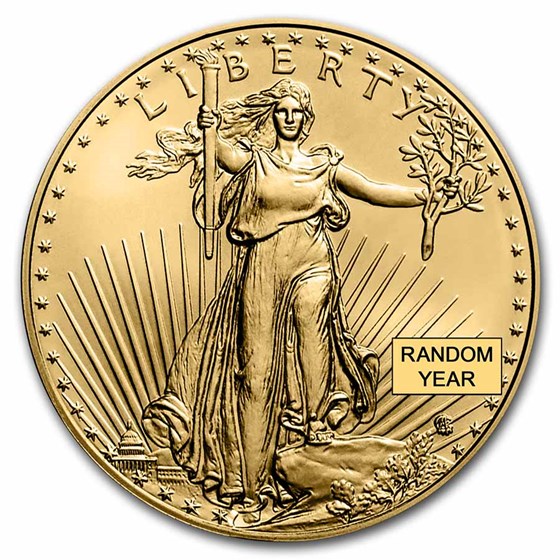
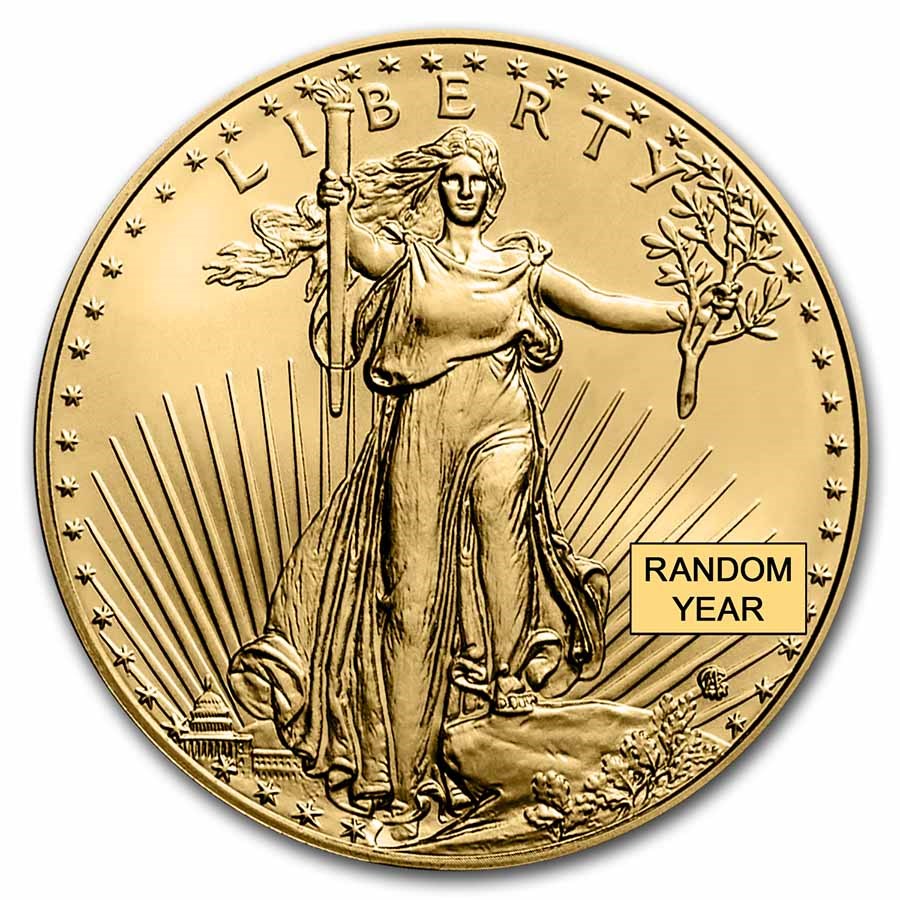
RETAIL BULLION GOLD EAGLE AT APMEX: Nearly $5000 $4,958.19

1 oz American Gold Eagle Coin BU (Random Year)

1 oz American Gold Eagle Coin BU (Random Year)
Top Pick 

$4,958.19


GEM MINT KROISOS STATER: (world's first gold coins)

$440,000 USD


LYDIAN KINGDOM. Croesus (561-546 BC). AV stater (16mm, 10.77 gm). NGC Gem MS★ 5/5 - 5/5, Fine Style. Croeseid "heavy" standard, Sardes, ca. 561-550 BC. Confronted foreparts of lion right (on left) and bull left (on right), each with outstretched foreleg / Two square punches of unequal size, side by side, with irregular interior surfaces. Rosen 660. BMC Lydia 30. Boston MFA 2068. Gulbenkian 756 (same dies). Berk "100 Greatest Ancient Coins," 9.1 (one same reverse die). Glistening in the light, this exceptional specimen boasts flawless preservation of the minute details in its Fine Style dies. The stoic bull and regal lion lack the animated expressions of the prototype dies it followed, showing the maturing style of the engravers.

QUEEN ANNE GOLD PEACE OF UTRECHT MEDAL $165,000


Gold Medal 1713. Peace of Utrecht. By J. Croker. Bust, laureate and draped. ANNA . D : G : MAG : BRI : FR: ET . HIB : REG: Rv. Britannia seated with olive-branch, spear and shield; beyond ships and farming scene. COMPOSITIS . VENERANTVR . ARMIS. In exergue: MDCCXIII. Plain edge. 59.3 mm. 122.00 g. Eimer 458. MI ii 399/256. van Loon V, 230,1. Saunders/Vanhoudt 1713-9. Sehr selten / Very rare. Prachtexemplar / Cabinet piece. Vorzüglich-FDC / About Uncirculated.


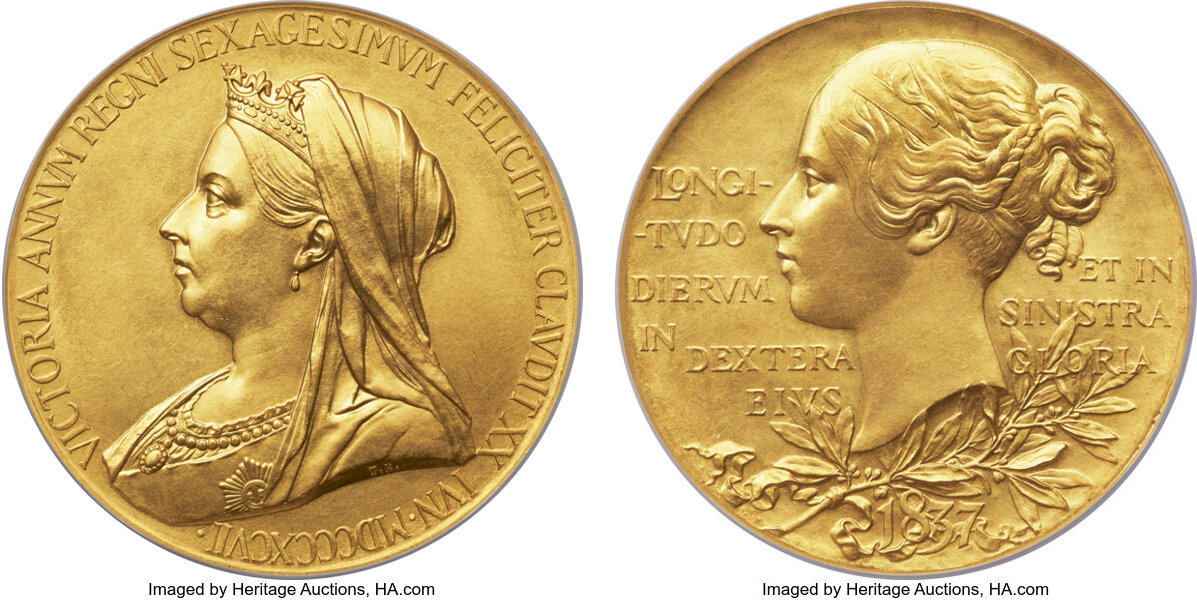
Great Britain: Victoria gold "Diamond Jubilee" Medal 1897 MS66 NGC,.

Sold on Jan 12, 2026 for:
$51,240.00


Amazing 10 ounce coin from 1609
Philip III, 1598-1621.
100 Escudos 1609, Segovia. PHILIPPVS · III · D · G Crowned shield. Aqueduct mint mark on the left. Value on the right / HISPANIARVM · REX · 1609 Spanish cross within quadrilobe. 339,35g. Calicó 1 (this coin); Cayón 5037; Cayón & Castán 1541.
NGC AU58 (top pop).


Starting price: 2 000 000 CHF
Lot 314 image

Price realized: 2 300 000 CHF


gorgeous augustus aureus

GORGEOUS AUGUSTUS AUREUS
AUGUSTUS AUREUS
Price realized: 400 000 CHF
 Find similar lots
Share this lot: Share by Email
ROMAN EMPIRE

Augustus, 27 BC - 14 CE.
Aureus circa 27-15, Pergamon (?). CAESAR Bare head right / Heifer walking left. 7,95g. Bahrfeldt 137; BMC 659; C 26; Calicó 168 (this specimen illustrated); CBN 1010; RIC 538.